
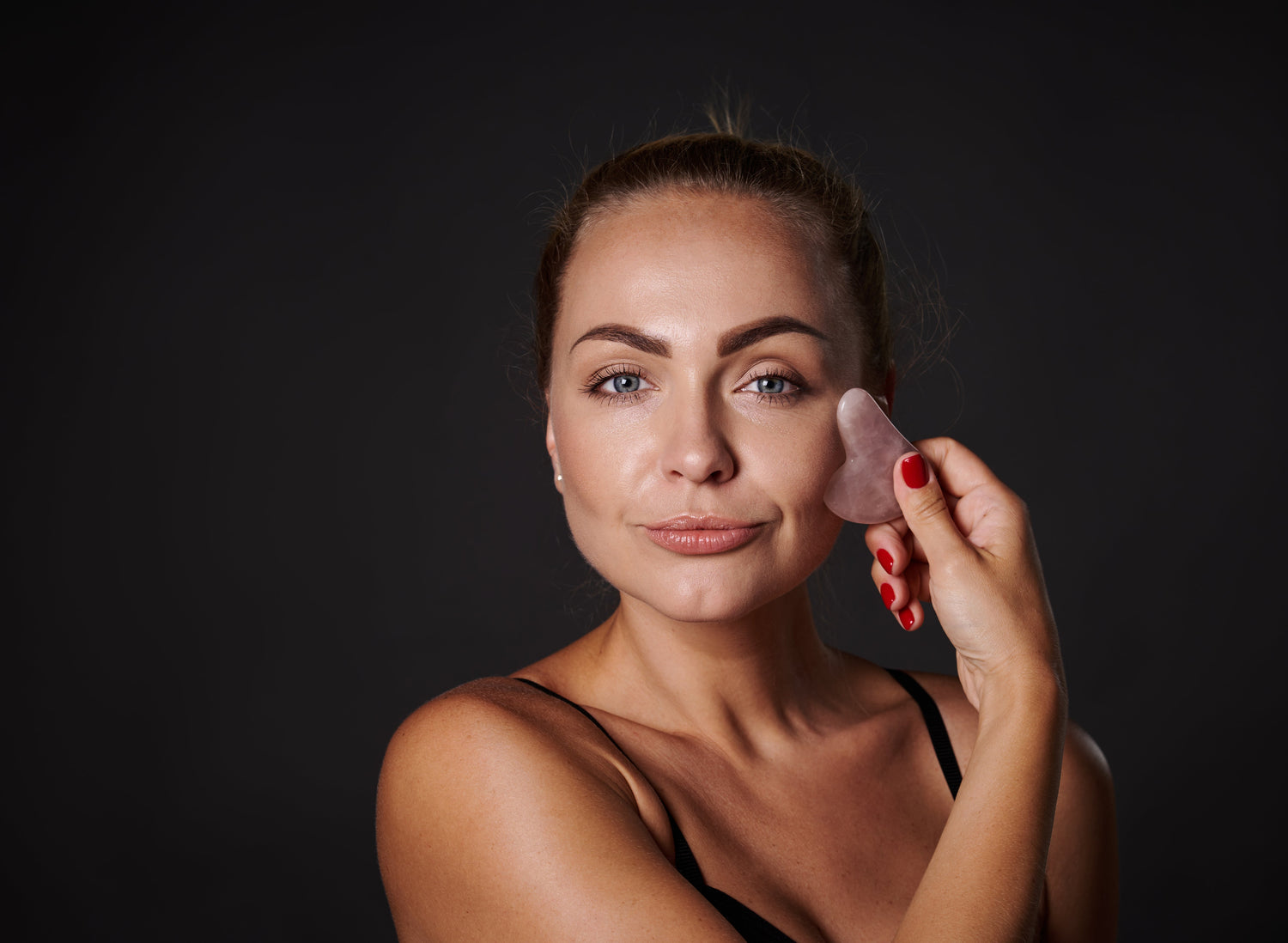
When something gains as much attention as gua sha has over the past few years, my first instinct is always the same. I look past the trend and dig into the research. It’s the same instinct that led me back to school for a diploma in organic cosmetic science — I wanted to understand what was actually happening in the skin, not just what was being marketed to it.
Gua sha facial massage is one of those practices that has become impossible to scroll past. There are tutorials in every corner of the internet, and stones in every shape, color, and material. But beneath the trend is something far older, and far more interesting. Gua sha has been practiced in traditional Chinese medicine for thousands of years, and modern research is now beginning to explore the physiological mechanisms behind it.
In this post, I want to walk you through what the science actually shows about gua sha facial massage, how it may support skin health when practiced gently, and exactly how to incorporate it into your routine in a way that respects sensitive skin. No hype, no aggressive scraping — just a grounded, evidence-informed look at a practice worth understanding.
An ancient practice having a modern moment
Gua sha translates roughly to “scraping,” and for centuries it has been used across the body as a technique to support circulation and ease tension. Traditional gua sha applied to the body is firm and intentional, and is sometimes practiced clinically by trained acupuncturists and traditional medicine practitioners.
What we’re talking about today is something gentler. Facial gua sha is a softened, modern adaptation. It uses light, controlled pressure with a smooth-edged stone tool to encourage microcirculation at the skin’s surface, support facial muscle relaxation, and create a more mindful pause in your skincare routine.
The shift from clinical body practice to gentle facial ritual matters. The studies I’ll walk you through were conducted on the broader gua sha tradition, but every credible practitioner working with the face emphasizes the same thing — gentle, controlled application is non-negotiable, especially for sensitive skin.
Does gua sha actually work? What the research shows
This is the question I get asked most often, so let’s answer it directly. The short answer is yes, the research supports several physiological effects of gua sha — particularly around circulation and tissue response. The longer answer is more nuanced, because the strongest data is in specific contexts, and a lot still needs to be studied.
Circulation and microcirculation
The most consistent finding in gua sha research relates to circulation. One human study observed that gua sha massage increased circulatory activity by an average of 1.85 times, suggesting enhanced blood flow in treated tissues [1]. A separate pilot study found that gua sha treatment increased local microcirculation by up to four times at the surface of the skin [2].
This matters because circulation is one of the unsung foundations of healthy skin. Blood flow is how nutrients, oxygen, and immune cells get to the skin. As part of the natural aging process, circulation to the skin can become less consistent, which can affect how efficiently the skin completes its renewal cycles and shows up in subtle changes to tone and texture.
Supporting circulation through gentle, intentional facial massage isn’t a quick fix or a replacement for your foundational skincare routine. But the research suggests it may be a meaningful, complementary practice for skin vitality over time.
Broader wellness research
While our focus is skin health, it’s worth noting that gua sha research extends beyond cosmetic applications. Clinical studies have explored its potential role in supporting recovery in weightlifting training [3], reducing fatigue and improving sleep quality in sports settings [4], and reducing pain and improving mobility in adults with chronic neck pain [5].
What ties all of this together is the same theme: circulation, tissue response, and nervous system regulation. These are systems that influence skin health indirectly as well, which is part of why gua sha is increasingly studied as a holistic wellness practice and not only a beauty ritual.
How gua sha supports skin health
When I think about why facial massage techniques like gua sha may be worth incorporating, I keep coming back to a few key mechanisms.
The first is circulation, which we’ve already covered. The second is muscle relaxation. Research has shown that facial massage can support facial skin blood flow and help relax facial muscles, which can soften the appearance of tension-related tightness over time [6]. Many of us hold tension in our face without realizing it, and a gentle massage practice can be a quiet way to release some of that.
The third is product application. Using a stone tool to apply a facial oil or serum can help distribute the product more evenly across the skin and encourages a slower, more intentional touch. For sensitive skin, this matters — being gentler with our skin and slowing down the application process can reduce the kind of friction and pressure that often triggers reactivity.
These benefits build over time. Gua sha is not a treatment that delivers a visible transformation overnight, and any product or practice that promises that kind of result is one I would question. What gua sha offers is gradual, consistent support — when practiced gently and regularly, as part of a well-formulated skincare routine.
How to do a gua sha facial massage at home, safely
If you’d like to try gua sha, here is a simple, safe way to begin. The most important rule is light pressure. If you can see redness lingering on your skin afterward, you are pressing too hard. Gua sha for the face is a gentle ritual, not an aggressive treatment.
Step 1: Start with clean, well-hydrated skin. Apply your usual cleanser, follow with any treatment products in your routine, and finish with a generous layer of facial oil or serum. The oil is what creates “slip” so the stone glides smoothly across your skin without pulling. Our Bloom facial oil was formulated specifically with sensitive skin in mind and pairs beautifully with a gua sha practice.
Step 2: Begin at the neck. Use upward strokes, working from the collarbone toward the jawline. Repeat each stroke three to five times.
Step 3: Move to the jawline and chin. Use slow, upward and outward motions, sweeping from the center of the chin out toward the ear. Three to five strokes per side.
Step 4: Work the cheeks. Sweep outward from the side of the nose toward the temple. The cheeks are where facial tension often hides, and slow strokes here can feel especially relieving.
Step 5: Continue to the under-eye area. This is the most delicate skin on your face. Use feather-light pressure and short, gentle strokes moving outward toward the temple.
Step 6: Sweep across the forehead. Move from the center outward, finishing with small circles at the temples to encourage relaxation.
Step 7: Care for your tool. After use, wash your gua sha stone with mild soap and warm water, or wipe it with rubbing alcohol. Allow it to dry fully before storing.
If you’d like a complete tool and oil pairing, our Gua sha + sleep oil kit includes both, designed to support a calming, sleep-friendly evening ritual. Already have a facial oil you love? The Renew gua sha stone on its own. If you want to see where gua sha fits alongside the rest of the evening, our night routine lays out the order step by step.
Common mistakes to avoid
A few things worth flagging before you start. Pressing too hard is the most common mistake, and it can lead to redness, broken capillaries, or barrier irritation, especially for sensitive skin. If your skin is reactive or you’re managing rosacea, eczema, or active breakouts, talk with your dermatologist before adding gua sha to your routine.
Skipping the oil is the second most common mistake. Gua sha without slip drags the skin and can cause more harm than good. And finally, expecting dramatic, immediate change. Gua sha is a practice that supports skin health gradually. Two to three sessions per week is a reasonable cadence for most people.
Is gua sha safe for sensitive skin?
For most people with sensitive skin, gua sha can be safe and even soothing — when practiced gently. The key is light pressure, consistent use of a generous facial oil, and listening to your skin. If your skin is in an active flare, breakout, or reactive state, it’s better to pause your gua sha practice until your barrier has recovered.
If you’re new to gua sha and have sensitive skin, start with one short session per week and pay attention to how your skin responds in the days that follow. Over time, you can build to two or three sessions per week if your skin is comfortable with the practice.
A grounded conclusion
Based on the current research, gua sha is not simply an internet trend. It’s a long-standing practice now being explored through modern scientific frameworks, and the evidence so far suggests that gentle, consistent gua sha facial massage may support circulation and skin vitality when used safely.
That said, no facial massage technique replaces foundational skincare. A simple, well-formulated routine — gentle cleansing, barrier-supportive hydration, and daily SPF — is still the most important investment you can make in your skin. Gua sha is something to layer on top, not something to lean on.
If you’d like to learn more about how we think about formulating for sensitive skin, you can read more about our science here. And if you have questions about gua sha or anything else, my inbox is always open at hello@loveandlightbotanicals.com.
Welcome to your healthy skin era. 🤍
— Kacie, Founder + Formulator, Love and Light Botanicals
References
- Dubinskaya AD, Yurova OV, Rogatkin DA, et al. Changes in microcirculation during gua sha massage. Bulletin of Rehabilitation Medicine. 2023;22(2):112–119. doi:10.38025/2078-1962-2023-22-2-112-119
- Nielsen A, Knoblauch NTM, Dobos GJ, Michalsen A, Kaptchuk TJ. The effect of gua sha treatment on the microcirculation of surface tissue: a pilot study in healthy subjects. EXPLORE. 2007;3(5):456–466. https://doi.org/10.1016/j.explore.2007.06.001
- Wang X, et al. Effects of gua sha therapy on weightlifting training: a randomized trial. J Tradit Chin Med. 2019;39(4):575–581. PMID: 32186106
- Wang X, Yu J, Chen P. Effects to resist sport fatigue based on heart rate variability with gua sha therapy. Journal of Shanghai University of Sport. 2021;45(7):76–83. doi:10.16099/j.sus.2021.07.008
- Braun M, et al. Effectiveness of traditional Chinese gua sha therapy in patients with chronic neck pain. Pain Medicine. 2011;12(3):362–369. https://doi.org/10.1111/j.1526-4637.2011.01053.x
- Koyama S, Kobayashi S. The effect of facial massage on facial skin blood flow and elasticity. Journal of Physical Therapy Science. 2016;28(1):90–93.