
We love sharing the science behind your skincare routine. With us, it’s always research over hype, so you can make informed choices that support long-term skin health.
Vitamin C has a reputation for being both a skincare powerhouse and, for sensitive skin, a bit of a gamble. It supports antioxidant defense and can support collagen production, plus it plays a role in skin firmness and tone over time.[3] We cover those benefits in more depth in our phytonutrients post. This one article answers a more practical question: is it actually safe for sensitive skin, and if so, what should you look for?
Why vitamin C has a reputation for irritation
The most-studied and most bioavailable form of vitamin C, L-ascorbic acid, is also the most unstable and the most likely to cause stinging or irritation, especially at high concentrations or low pH.[1] Because L-ascorbic acid needs a fairly acidic formula to stay stable and absorb well, many vitamin C serums are formulated at a pH that can be genuinely irritating for sensitive or barrier-compromised skin.
That instability is also why vitamin C serums are notorious for oxidizing as they age. An oxidized formula isn't just less effective, it can be more irritating too.[1] This is the form most people picture when they think “vitamin C serum,” and it's a reasonable reason to be cautious, but it isn't the only way to formulate with vitamin C.
A gentler path: vitamin C derivatives like magnesium ascorbyl phosphate
L-ascorbic acid isn't the only active form of vitamin C available to formulators. Derivative forms, where vitamin C is stabilized by binding it to another molecule, address the instability problem at its source rather than trying to manage it with a very low, irritating pH.
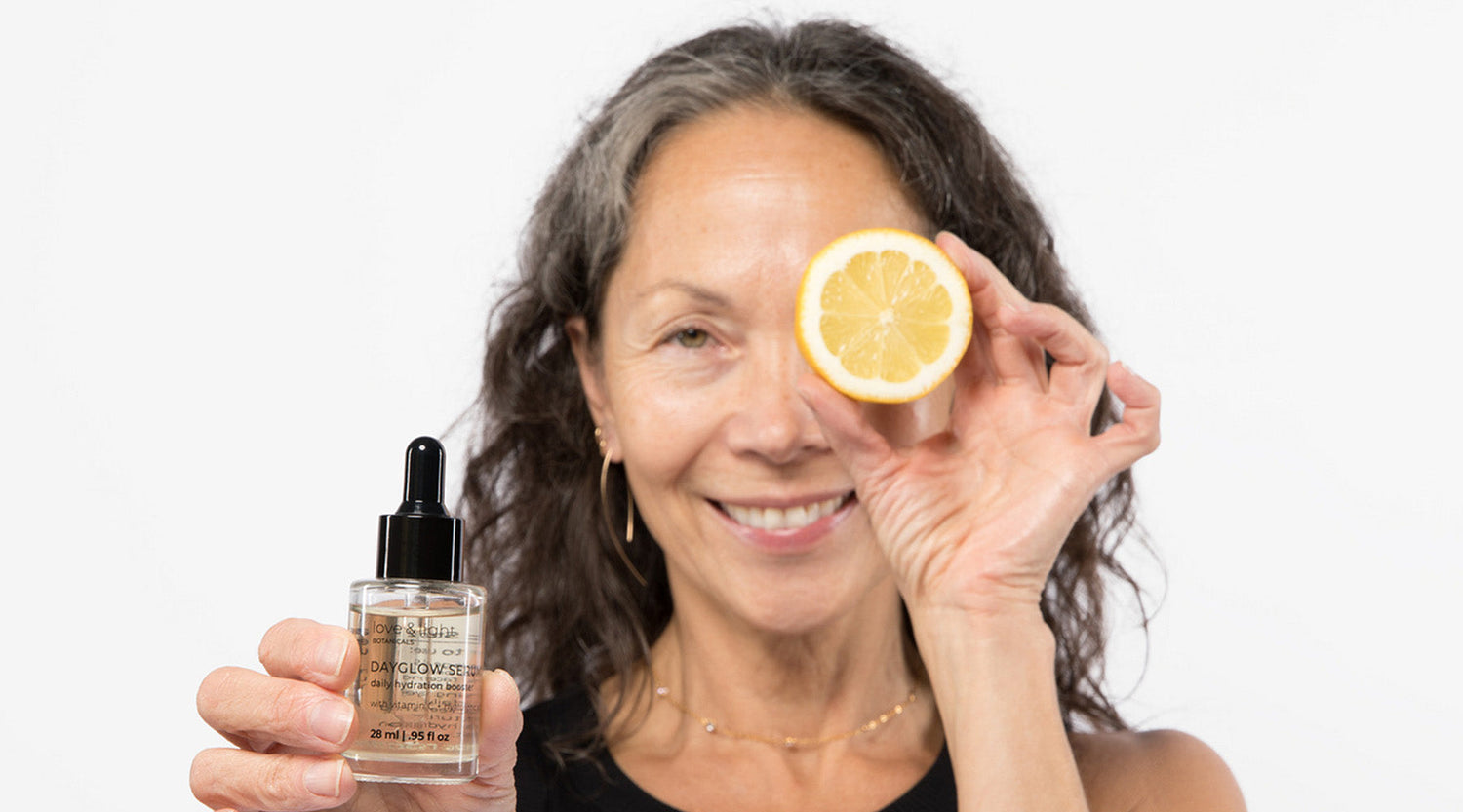
Magnesium ascorbyl phosphate (the vitamin C derivative we formulate with in our Dayglow vitamin C serum and Velvet vitashield) is one of the more well-studied examples. Because it's a phosphate ester of ascorbic acid, it doesn't require an acidic environment to stay stable, which means it can be formulated at a skin-friendlier pH from the start. Once applied, skin enzymes gradually convert it into active ascorbic acid, so it still delivers antioxidant and brightening support, just released more gradually and with less of the irritation risk tied to raw L-ascorbic acid.
Research on magnesium ascorbyl phosphate specifically has shown it inhibits melanin formation in both lab and clinical settings, supporting its use for tone and brightening.[4] A more recent randomized, double-blind clinical trial combining magnesium ascorbyl phosphate with niacinamide and hyaluronic acid found the combination to be safe and well tolerated over 60 days of use, including in comparison to a standard brightening treatment.[5]
So is it actually safe for sensitive skin?
The ingredient itself isn't inherently unsafe, its irritation potential can be impacted by ingredient concentration, pH, and formula stability, not on vitamin C as a category. Sensitive skin, by definition, reacts more easily to stimuli that wouldn't bother other skin types,[2] which makes it more likely to notice a poorly buffered or overly acidic vitamin C formula, not necessarily incompatible with vitamin C altogether.
In practice, this means sensitive skin usually tolerates vitamin C better in a moderate concentration, in a more stable, buffered, or derivative form like magnesium ascorbyl phosphate, and formulated alongside barrier-supportive ingredients rather than alone at a high, low-pH concentration.
What to look for in a gentler vitamin C formula
A stabilized derivative, not raw L-ascorbic acid. Forms like magnesium ascorbyl phosphate are formulated at a gentler pH from the start, which removes the biggest driver of vitamin C irritation before it becomes a problem.[4],[5]
A moderate, well-formulated concentration. More isn't automatically better. A moderate concentration in a stable, well-buffered formula is often better tolerated than a high concentration that's more likely to irritate.
Supporting ingredients, not just vitamin C alone. Formulas that pair vitamin C with hydrating and barrier-supportive ingredients, like hyaluronic acid, tend to be better tolerated than vitamin C in isolation.
Stability signals. A vitamin C serum should stay clear or pale, noticeable darkening or a change in smell is a sign the formula has oxidized and may be more likely to irritate than when it was fresh.
Fragrance-free. As with any product for sensitive skin, removing synthetic fragrance removes one more variable that could compound irritation.
How to introduce it if you have sensitive skin
Gentler, derivative forms like magnesium ascorbyl phosphate generally require less caution than raw L-ascorbic acid, but it's still smart to patch test on a small area first and introduce it gradually, a few times a week before working up to daily use. If you notice ongoing stinging beyond the first few uses (some very brief tingling on application is common and not necessarily a problem), that's a sign to scale back frequency or reconsider the formula.
The takeaway
Sensitive skin can generally tolerate a thoughtfully formulated vitamin C serum, especially one built around a stabilized derivative like magnesium ascorbyl phosphate and paired with hydrating, barrier-supportive ingredients, rather than raw L-ascorbic acid used at a high concentration alone.
Frequently asked questions
Can sensitive skin use vitamin C at all? Generally, yes, in a moderate concentration and stable formulation. Irritation potential can be impacted by ingredient concentration, pH, and formula stability.[1]
Why does my vitamin C serum sting? This is often related to a low formula pH needed to stabilize L-ascorbic acid, the most common and most bioavailable form of vitamin C. Look for a more gentle version of Vitamin C like Magnesium Ascorbyl Phosphate.[1]
What's the difference between L-ascorbic acid and magnesium ascorbyl phosphate? L-ascorbic acid is the most bioavailable and most studied form, but it's unstable and needs a low, often irritating pH to work. Magnesium ascorbyl phosphate is a stabilized derivative that performs well at a gentler pH and converts to active vitamin C once absorbed, which is why we formulate with it.[4],[5]
How do I know if my vitamin C serum has gone bad? Watch for color change, a serum turning orange, or brown, or a change in smell. Both are signs of oxidation, which reduces effectiveness and can increase irritation.[1]
References
- Telang PS. Vitamin C in dermatology. Indian Dermatol Online J. 2013;4(2):143–146. https://doi.org/10.4103/2229-5178.110593
- Misery L, Ständer S, Szepietowski JC, et al. Definition of sensitive skin: an expert position paper from the special interest group on sensitive skin of the International Forum for the Study of Itch. Acta Derm Venereol. 2017. https://doi.org/10.2340/00015555-2397
- Pullar JM, Carr AC, Vissers MCM. The roles of vitamin C in skin health. Nutrients. 2017;9:866. https://doi.org/10.3390/nu9080866
- Kameyama K, Sakai C, Kondoh S, et al. Inhibitory effect of magnesium L-ascorbyl-2-phosphate (VC-PMG) on melanogenesis in vitro and in vivo. J Am Acad Dermatol. 1996;34(1):29–33. https://doi.org/10.1016/S0190-9622(96)90830-0
- Barbosa M, Perez de Amorim R, Cassiano D, et al. Efficacy and safety of nicotinamide 10%, associated with magnesium ascorbyl phosphate 5% and hyaluronic acid 5%, compared to hydroquinone 4% in women with facial melasma: a randomized, double-blind, controlled clinical trial. Clin Cosmet Investig Dermatol. 2024;17. https://doi.org/10.2147/CCID.S473224